Discover the CAN XL protocol, the extension to CAN FD that offers Ethernet-level speeds and much larger data packets for transmitting Ethernet frames.
Vehicle networks
In the rapidly changing landscape of automotive electronics, modern vehicles have been transformed from purely mechanical systems into advanced network platforms. Today, cars are equipped with a dense network of sensors and controllers, which constantly exchange large amounts of data to support intelligent, software-controlled functionality. Car manufacturers use the term “Software-Defined Vehicles” to describe this.
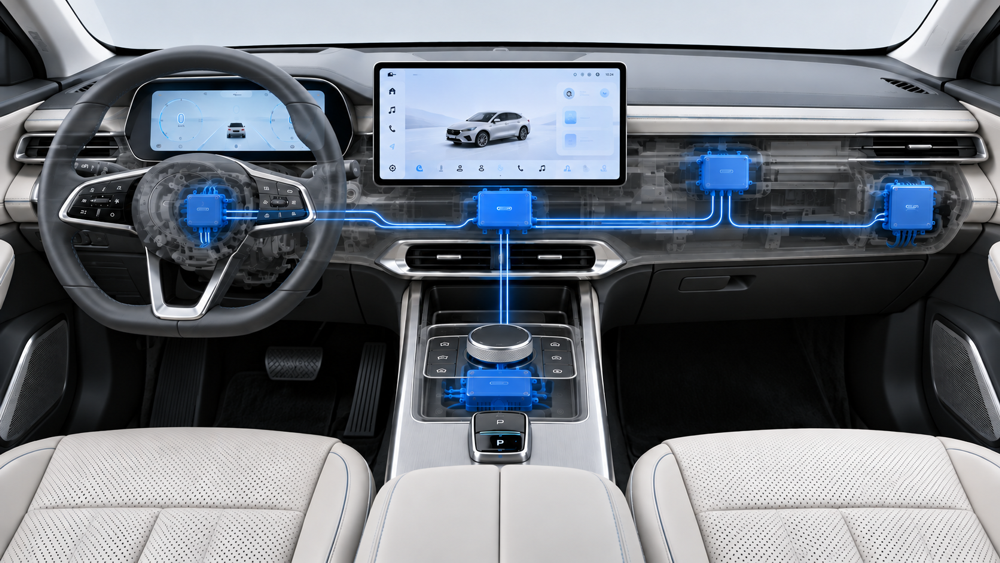
In addition, Battery Electric Vehicles (BEVs) have entered the market. They do not have the traditional internal combustion engine, transmission(s) and other drive components controlled by individual ECUs. EVs adopt an integrated approach in which battery management and power management are intertwined.
Communication in software-defined cars is shifting from classic signal-defined communication – such as that intended for the CAN bus – to service-oriented communication as used in IT networks.
Traditional protocols such as CAN and CAN FD are not designed for this purpose, nor were they intended to be. However, traditional signal-based communication will continue to account for a large proportion of all automotive communication in the future. This presents the automotive industry with technical challenges. Cars are a consumer product in a highly competitive market where high reliability of electronics and, at the same time, minimising costs are of paramount importance.
Simply replacing all CAN nodes with Ethernet nodes is a highly complex solution that offers no advantages but brings mainly disadvantages. Equipping a large number of ECUs with both a CAN FD and an Ethernet network connection is ultimately not the best solution either, as it makes the topology complex and less reliable.
CAN XL
At Volkswagen’s suggestion, the German automotive industry has developed CAN XL – where XL stands for ‘eXtra Long’ – a new variant of CAN, alongside CAN Classic and CAN FD. CAN-XL is the next generation of the Controller Area Network family, designed to meet the bandwidth, reliability and scalability requirements of modern automotive and industrial systems. The key changes at a glance:
- Higher speed
CAN XL supports bit rates of up to 20 Mbit/s, bringing it into the realm of Ethernet speeds. - Much more data
The data field has been increased to 2048 bytes. This enables the use of protocols at higher IT layers, such as IP, and even the tunnelling of complete Ethernet frames - Interoperability with CAN FD
CAN FD works alongside CAN XL without the need for any modifications. This means that mixed CAN FD / CAN XL networks can be deployed immediately. - Security
The optional CANsec security protocol forms a building block for meeting future cyber security requirements. - Frame fragmentation
Ability to defer the transmission of longer frames to meet the real-time requirements of control applications. - Virtual CAN Network ID
Assigns CAN frames to virtual networks, similar to VLANs in Ethernet. - Other modifications
Improved three-phase CRC architecture, improved priority handling and increased robustness
However, CAN-XL is not simply an extension of CAN-FD: it is a new protocol layer that remains compatible with the CAN ecosystem whilst enabling high-bandwidth, low-latency communication for the next generation of ECUs, sensors and gateways. CAN-XL also requires a new type of transceiver to achieve these high speeds.

CAN XL vs Automotive Ethernet
CAN XL offers data rates of up to 10–20 Mbit/s, which is a huge leap forward for CAN. In terms of pure bandwidth, however, this is no match for Automotive Ethernet, which typically operates at 100 Mbit/s (100BASE-T1) nowadays.
Throughput is, however, only one aspect: real-time behaviour and determinism are equally important in automotive control systems. Here, CAN XL has an inherent advantage thanks to CAN’s arbitration mechanism: short, high-priority messages are transmitted almost immediately, with a maximum delay in the microsecond range, as soon as the bus is free. Ethernet lacks a real-time structure or prioritisation. This can be added – think of industrial protocols such as PROFINET IRT or EtherCAT – but that makes such protocols expensive and complex.
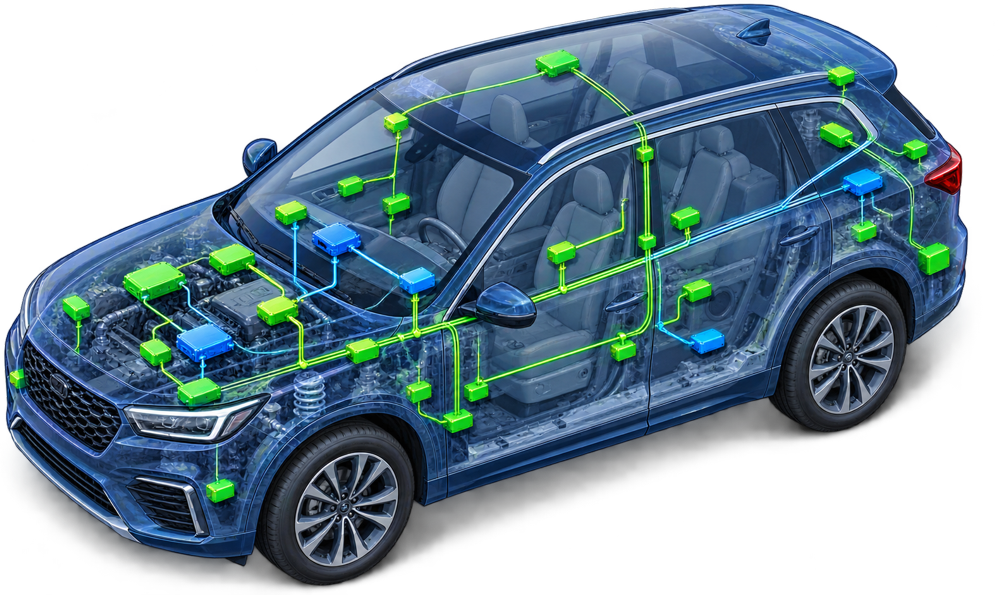
The CAN bus is so widely used in cars because it is both reliable and inexpensive. CAN controllers are integrated into microcontrollers, the transceiver is an inexpensive component, and the cabling – twisted pairs in a wiring harness – is lightweight and simple.
Traditionally, an Ethernet node has been built around expensive PHY chips, line drivers and multi-twisted-pair shielded cabling. Automotive Ethernet has therefore been cost-optimised from the outset. It uses single-pair unshielded cables and compact PHYs. However, it remains Ethernet, so active network components – such as hubs or switches – are required, rather than just a two-wire bus. The software overhead is also higher with Ethernet because TCP/IP or SOME/IP stacks are required. This, in turn, places demands on the microcontroller’s processing power.
This makes Ethernet more expensive and complex, particularly for simple nodes.
The CAN bus has an extensive ecosystem that has been built up over more than 30 years – diagnostic tools, software stacks (OBD-II diagnostics, J1939, CANopen) and a large number of engineers who are familiar with it. CAN XL benefits from backward compatibility: it can utilise existing software (with updates to support larger payloads) and is already incorporated into AUTOSAR – the standard software platform for the automotive industry. Test equipment suppliers such as PEAK System and others have already added support for CAN XL to their analysers and test equipment, enabling developers to work with CAN XL in the same way as with CAN or CAN FD.
Ethernet, on the other hand, brings with it the vast ecosystem of IT and computer networks. This represents a huge wealth of technology – such as protocols, security and existing chips from the consumer industry – but also poses a risk and involves a learning curve when it comes to applying it reliably in the automotive industry.
| Feature | CAN XL | Automotive Ethernet |
|---|---|---|
| Max Data Rate | Up to 20 Mbit/s | Up to 10 Gbit/s |
| Payload Size | Up to 2048 bytes | Typically 1500 bytes (MTU) |
| Transmission Medium | Twisted Pair (120 Ω) | Twisted Pair, Coax, Fiber |
| Typical Topology | Line with small stars | Star, tree, ring structures |
| Key Use Cases | Zonal architectures, tunneling, sensor fusion | Infotainment, backbone, high-bandwidth apps |
| Backward Compatibility | Full with CAN CC and CAN FD | None |
In short, CAN XL is not intended to compete with Ethernet, but to complement it. It is compatible with CAN FD, meaning that CAN XL can be used alongside existing CAN FD nodes.