From CAN Classic to CAN XL
The development of CAN has always been driven by the growing demand for bandwidth and efficiency. CAN Classic offered up to 1 Mbit/s and eight data bytes per frame, which was sufficient for decades. CAN FD expanded this to 64 data bytes and enabled flexible switching between bit rates within the data phase, up to a speed of 8 Mbit/s. CAN XL – XL stands for ‘eXtra Long’ – is now continuing this development by supporting payloads of up to 2,048 bytes per frame and data rates of up to 20 Mbit/s in fast mode. With these capabilities, CAN XL not only surpasses its predecessors but also positions itself as a bridging technology between traditional fieldbuses and high-speed Ethernet networks.
| CAN Classic | CAN FD | CAN XL | |
|---|---|---|---|
| Data field | 0–8 bytes | 0–64 bytes | 0–2048 bytes |
| Bit rates | |||
| Arbitration | Max 1 Mb/s | Max 1 Mb/s | Max 1 Mb/s |
| Data phase | Max 1 Mb/s | Max 12 Mb/s | Max 20 Mb/s |
| Message structure | |||
| Type | Standard & Extended | FD Standard & FD Extended | XL Structure |
| CRC | 15-bit (11-bit standard) | 17 or 21-bit | 32-bit |
| Bit stuffing | Standard | Enhanced | Optimised |
| CRC | 15-bit (11-bit standard) | 17 or 21-bit | 32-bit |
| Error handling | Standard | Enhanced | Further enhanced |
| Applications | |||
| Sensors, Legacy | Mid-speed ECUs, Diagnostics | ADAS, ECU Backbone | |
Structure and frame format
At the heart of CAN XL lies the XL Frame Format (XLFF), which is structured entirely differently from the familiar CAN frame structure. One of the most significant innovations is the splitting of the identification code into two parts. The 11-bit priority identifier is used for arbitration, whilst the 32-bit acceptance field serves as a flexible addressing and filtering mechanism. This split allows messages to be prioritised and routed more efficiently.
As a result of this choice, CAN XL no longer supports Extended Message IDs. CAN XL is not intended for this purpose anyway, and J1939 FD, for example, is more than adequate.

The frame structure also introduces additional fields in the Ctrl section, which enhance the protocol’s versatility. The Service Data Unit Type (SDT) defines which higher-layer protocol is being transported, enabling the tunnelling of CAN FD or the transmission of IP packets. The Virtual CAN Network ID (VCID) allows up to 256 logical networks to run on a single physical segment, similar to VLANs in Ethernet.
Another addition is the Simple Extended Content (SEC) bit, which indicates whether further headers, such as those for encryption or fragmentation, are included. Together, these features ensure that CAN XL can function as a highly flexible platform that supports both legacy applications and modern, data-driven architectures.

Data integrity and reliability
As data fields grow larger, ensuring reliability becomes even more important. CAN XL introduces two cyclic redundancy check (CRC) fields to safeguard transmissions: the Preface CRC protects the control information, whilst the Frame CRC safeguards the entire frame. This cascaded approach achieves a Hamming distance of six, meaning that up to five randomly distributed bit errors can be reliably detected. Such robustness is crucial when transporting large payloads or safety-critical data in automotive and industrial environments.
The frame structure also introduces additional fields in the Ctrl section, which enhance the protocol’s versatility. The Service Data Unit Type (SDT) defines which higher-layer protocol is being transported, enabling the tunnelling of CAN FD or the transmission of IP packets. The Virtual CAN Network ID (VCID) allows up to 256 logical networks to run on a single physical segment, similar to VLANs in Ethernet.
Another addition is the Simple Extended Content (SEC) bit, which indicates whether further headers, such as those for encryption or fragmentation, are included. Together, these features ensure that CAN XL can function as a highly flexible platform that supports both legacy applications and modern, data-driven architectures.
CAN XL and CAN FD Mixed-mode
Like its predecessor, CAN FD, CAN XL has been designed with backwards compatibility in mind, enabling seamless access to both CAN FD and classic CAN protocols.
Conversely, a CAN FD node cannot directly receive a CAN XL message. As soon as it detects an XL frame, the CAN FD node will temporarily cease to participate in the communication. However, it will not register an error and will resume participation with the next frame.
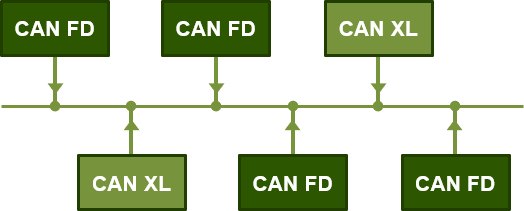
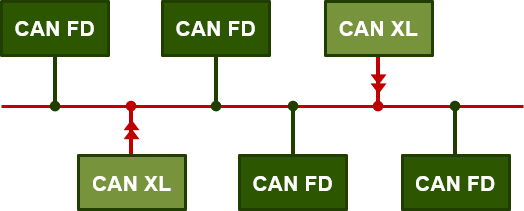
This dual use of CAN FD and CAN XL on one and the same bus is made possible by utilising the CAN FD Protocol Exception State. This state is triggered by the XL bit of a CAN XL frame, immediately following the 11-bit arbitration. When this recessive XL bit in a CAN XL message places the CAN FD node into the Protocol Exception State, a safety measure introduced in the CAN FD specification (ISO 11898-1:2015) with a view to future extensions.
CAN Classic nodes cannot be combined with CAN XL on the same bus