Flexible bus speed
As described in detail in the article CAN Bus speed and length, with CAN, the maximum bus length and the maximum bit rate are inversely proportional. This relationship stems from the bus arbitration mechanism used, whereby other nodes can override a recessive bit with a dominant bit. After all, this must take place within the bit time and depends on the signal speed through the bus (approximately 5 nsec/m).
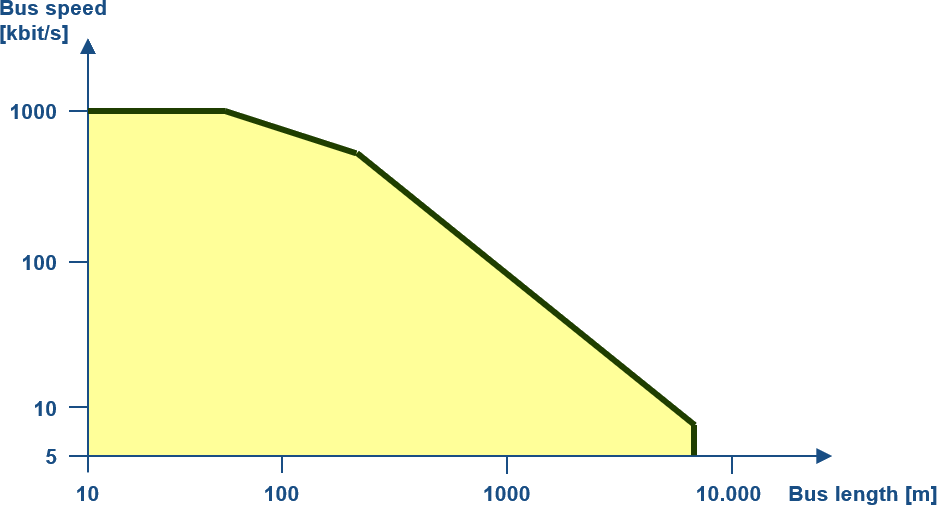
Simply increasing the bus speed would therefore unacceptably limit the maximum bus length. For this reason, CAN FD employs flexible bus timing: during the arbitration phase, the factors mentioned above—bus length and speed—are crucial. Consequently, in CAN FD, the maximum bus speed is limited during this phase and is exactly the same as in CAN Classic, i.e. a maximum of 1 Mbit/sec.
Once the data bytes are transmitted within the CAN message, the direction is irrelevant because communication is now unidirectional: from the master to the slave(s). This is where CAN FD can increase the bus speed. Using standard NRZ bit encoding and the standard ISO 11989-2 ‘CAN High Speed’ physical layers, the speed of CAN FD can be increased to at least 8 Mbit/sec whilst transmitting the data bytes, as recommended by CiA (CAN in Automation). We shall refer to this hereafter as accelerated data transmission.
Once the data bytes have been transmitted, there is another arbitration phase, during which the CRC is exchanged and the slaves respond with an acknowledge. As communication is bidirectional again at this stage, the familiar dependency re-emerges and the speed is once more limited to CAN Classic, i.e. a maximum of 1 Mbit/sec
The use of different bus speeds in CAN FD has been resolved by the introduction of two sets of bus timing registers. The first set is the standard set, as also found in CAN Classic. The second set is only used during accelerated data transmission. If both sets have the same values, then there is no accelerated data transmission.


Average bus speed
CAN FD therefore involves multiple bus speeds. Consequently, it is not possible to speak of ‘the’ bus speed, as with CAN 2.0, but rather of an average bus speed. This average depends not only on the chosen standard and accelerated data bus speeds, but also on the number of data bytes being transmitted. The more data bytes that are transmitted, the higher the proportion of accelerated data bus speed in the total message, which increases the average bus speed (for that message).
The diagram below shows the average bus speed for different numbers of data bytes (8 to 64) in relation to the bus speed during accelerated data transmission.
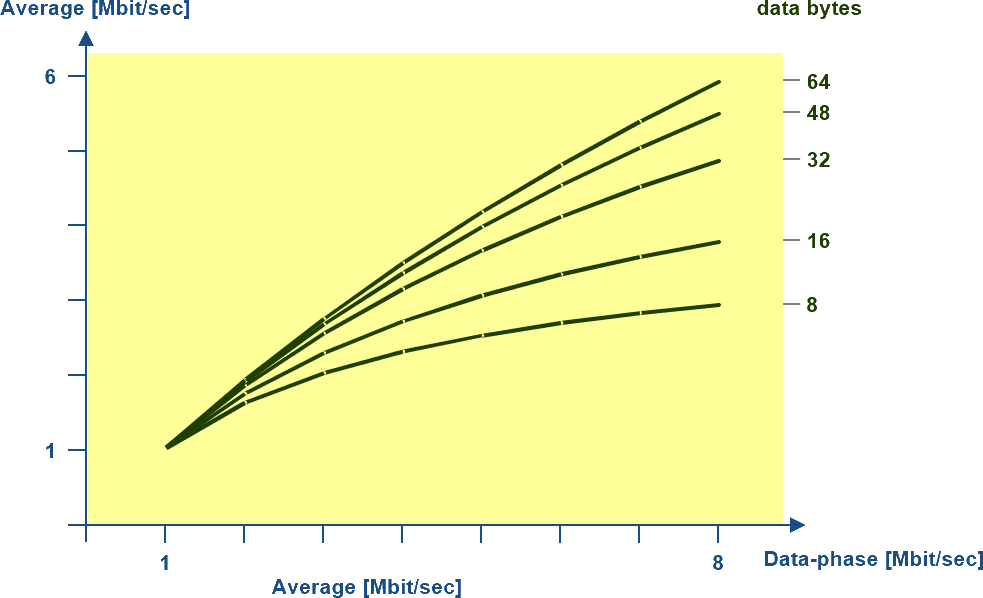
On this basis, the table below sets out the bus speed and message duration for a few standard parameters.
| Data | Bit rate | Message | |||
|
Type |
bytes |
Standard |
Data |
Average |
duration |
| CAN 2.0 | 8 | 1 Mbit/s | 111 µs | ||
| CAN FD | 8 | 1 Mbit/s | 4 Mbit/s | 2,3 Mbit/s | 50,75 µs |
| CAN FD | 8 | 1 Mbit/s | 8 Mbit/s | 2,9 Mbit/s | 39,875 µs |
| CAN FD | 64 | 1 Mbit/s | 4 Mbit/s | 3,5 Mbit/s | 163,75 µs |
| CAN FD | 64 | 1 Mbit/s | 8 Mbit/s | 5,9 Mbit/s | 96,375 µs |
CAN FD therefore significantly reduces the bus load: when comparing CAN FD with CAN Classic, the bus load for transmitting 64 bytes (96.375 µs versus 8 × 111 µs) has been reduced by just under 90 1/p>
It will, incidentally, be clear that if a message contains no data bytes, CAN FD offers no advantage because there is no accelerated transmission to speak of. For this reason, ‘Remote Request’ messages, which also contain no data, cannot be transmitted as CAN FD but only as CAN Classic.
Higher bus speeds
As mentioned, standard NRZ bit encoding and the standard ISO 11989-2 ‘CAN High Speed’ physical layers allow accelerated data transmission up to 8 Mbit/sec. However, special CAN FD physical layers have been developed to reliably and interference-free achieve speeds of up to approximately 12 Mbit/sec. To ensure compatibility, CAN FD controllers are equipped with control signals to switch between physical layers during high-speed transmission, from the standard (CAN-compatible) ISO 11989-2 to this faster interface.