Find out about the technology behind the CAN FD protocol, the successor to CAN Classic, which offers higher data rates and more data bytes for increased data transfer.
CAN Classic limitations
More than ten years after CAN was developed, communication began to reach its limits. CAN was essentially developed to control the powertrains of internal combustion engines – with an update every half crankshaft revolution – and as a replacement for wiring harnesses in all standard electrical systems. In itself, this worked extremely well. Due to environmental requirements and the increase in comfort systems, the number of CAN messages did indeed rise enormously. However, as a result of developments in electronics, CAN had become so inexpensive that car manufacturers simply implemented multiple CAN networks in parallel.
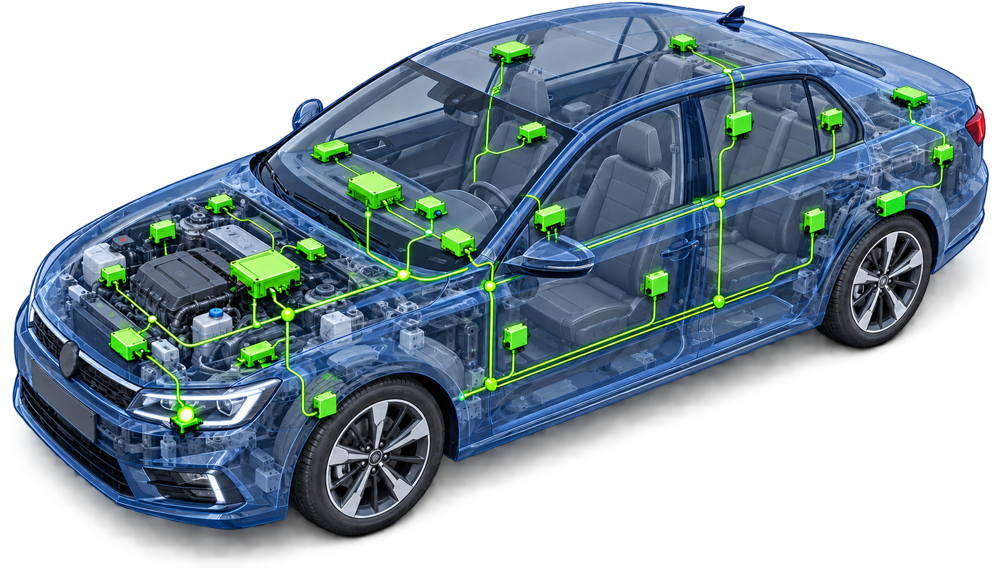
However, the first advanced driver assistance systems were devised in the development centres. These required significantly more bandwidth than CAN could offer at the time. The efficiency of CAN Classic is also limited. To make CAN as reliable and error-free as possible, the overhead is high. To send a CAN Classic message with an 11-bit ID and 8 data bytes, 108 bits are required. That represents an overhead of almost 70 per cent.
In addition to future developments, a short-term problem also arose. An increasing number of ECUs could be updated retrospectively. However, downloading software via CAN Classic took a long time. This became a problem both in production and in the workshop.
CAN, but with a difference
There was therefore a need to define a new communication standard. At the same time, the automotive industry wanted to stick with CAN. The protocol is already widely used, is cost-effective and reliable. Furthermore, the technology is well-known throughout the entire supply chain.
Furthermore, the real-time behaviour of CAN was not to be altered. The automotive industry has invested a great deal of effort into extracting and transmitting CAN messages at the right moment. They all use models in which this has been fully worked out. The new protocol must not affect this behaviour.

CAN FD
In 2022, Bosch introduced CAN FD. FD stands for Flexible Data-rate.
It works exactly the same as CAN. Once arbitration has been won, CAN FD switches to a much higher clock speed for transmitting the data. Hence the name ‘Flexible Data Rate’. It is also possible to transmit far more than eight data bytes. Once the data has been transmitted, CAN FD switches back to the ‘standard’ CAN speed for the acknowledgement and termination.
CAN FD Advantages
The advantages at a glance:
- More data
CAN FD supports up to 64 data bytes per data frame, compared with 8 data bytes in CAN Classic. This reduces protocol overhead and leads to improved protocol efficiency. - Increased speed
CAN FD supports two bit rates: the nominal (arbitration) bit rate, limited to 1 Mbit/s as with CAN Classic, and the data bit rate. In practice, data bit rates of up to 12 Mbit/s are achievable, depending on the transceivers. - Higher reliability
CAN FD utilises an improved cyclic redundancy check (CRC) and the ‘protected stuff-bit counter’, thereby reducing the risk of undetected errors. This is, for example, crucial in safety-critical applications such as vehicles and industrial automation. - Transition
CAN nodes that support either CAN Classic or CAN FD exclusively can be combined under certain conditions. This enables a gradual introduction of CAN FD nodes, thereby significantly reducing costs and complexity for OEMs.
CAN FD ISO vs non-ISO
The original CAN FD specification from 2012 contained an error in the definition of the CRC, which meant that fewer errors could be detected than with CAN Classic. The final standardised ISO 11898-1:2015 protocol redefines the CRC calculation. Unfortunately, this is not compatible with the non-ISO Bosch CAN FD 1.0 specification from 2012. Consequently, a CAN FD bus cannot accommodate a mix of ISO and non-ISO nodes.
The vast majority of CAN devices support both CAN FD ISO and non-ISO